

Tankless Water Heater vs Tank Water Heater: Which One Makes Sense for Your South Florida Home
Your water heater just died. Maybe the bottom rusted out and flooded the garage. Maybe you noticed the hot water running out faster than it used to. Either way, you are standing in front of a decision that will affect your utility bills, your daily comfort, and your wallet for the next 10 to 20 years. The tankless water heater vs tank water heater debate is one of the most common questions homeowners in Palm Beach County ask when it is time for a replacement.
This guide breaks down both options honestly. We will cover how each system works, what they cost to buy and install, how long they last, how they perform in South Florida’s unique climate, and which situations favor one over the other. DC Plumbing of South Florida is a family owned, licensed master plumber operation serving Palm Beach County, and we install both tank and tankless systems every week. The goal here is not to push you toward one option. It is to give you the information you need to make the right call for your home.
VIDEO EMBED: Insert the Tank vs Tankless Water Heater video (Tank_vs_DC_Plumbing.mp4) here using the WordPress Video block. Upload the MP4 to the media library first, then embed it inline. This video should autoplay muted with controls visible. Recommended caption: “Tank vs Tankless Water Heater: A Quick Visual Breakdown from DC Plumbing of South Florida.”
Suggested: Add a jump link table of contents directly below the video for the live WordPress version.
How Tank and Tankless Water Heaters Work
Tank (Storage) Water Heaters
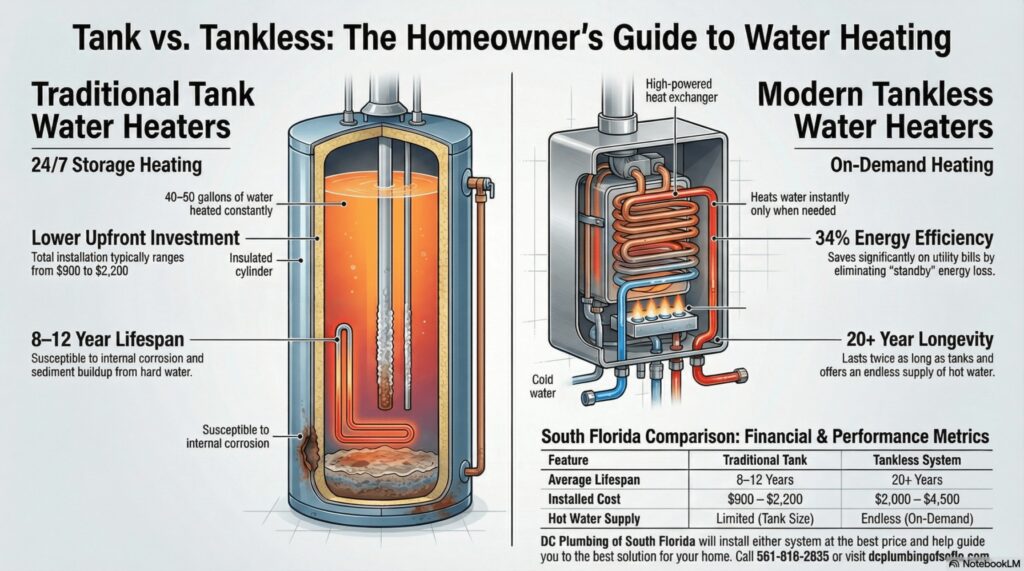
A tank water heater is a large insulated cylinder, typically 40 to 50 gallons for a residential home, that stores water and keeps it heated around the clock. When you turn on a hot water faucet, water flows out of the top of the tank and cold water enters the bottom to be heated. The tank uses either an electric heating element or a gas burner to maintain the water at a set temperature, usually around 120 degrees Fahrenheit.
The tradeoff is what the industry calls standby heat loss. Because the tank keeps water hot 24 hours a day whether you use it or not, energy is constantly being consumed to maintain that temperature. In South Florida, where ambient temperatures in garages and utility closets regularly exceed 85 degrees, standby loss is slightly lower than in northern climates, but it still adds up over the life of the unit.
Tankless (On Demand) Water Heaters
A tankless water heater does not store water at all. When you open a hot water tap, cold water flows through a heat exchanger powered by a gas burner or electric element, and the water is heated instantly as it passes through. Once you close the tap, the unit shuts off. No storage, no standby loss.
Tankless units are sometimes called on demand water heaters because they only fire when hot water is requested. They are compact, usually about the size of a small carry on suitcase, and mount directly to a wall. In South Florida homes where garage space and utility closets are at a premium, the size difference is noticeable.
Cost Comparison: Purchase, Installation, and Long Term
This is the question everyone asks first, so let us get straight to the numbers.
A standard 50 gallon electric tank water heater typically costs between $400 and $1,200 for the unit itself. Installation runs $500 to $1,000 in most cases, bringing your total to roughly $900 to $2,200. For homes across Boynton Beach, Delray Beach, and Lake Worth, this is the most common setup DC Plumbing installs when homeowners are replacing an existing tank unit with the same type.
A tankless water heater unit costs between $1,000 and $3,000 depending on the brand, capacity, and fuel type. Tankless water heater installation costs are higher as well, typically $1,000 to $1,500, because the job may require upgrading electrical panels, installing new gas lines, or modifying venting. Total installed cost for a tankless system usually lands between $2,000 and $4,500.
That is a significant difference upfront. But the long term picture is where the math shifts. The U.S. Department of Energy estimates that homes using 41 gallons or less of hot water daily can save 24 to 34 percent on water heating energy costs with a tankless unit compared to a conventional tank. For an average household, that translates to roughly $100 per year in savings on a gas tankless unit and about $44 per year on an electric tankless unit.
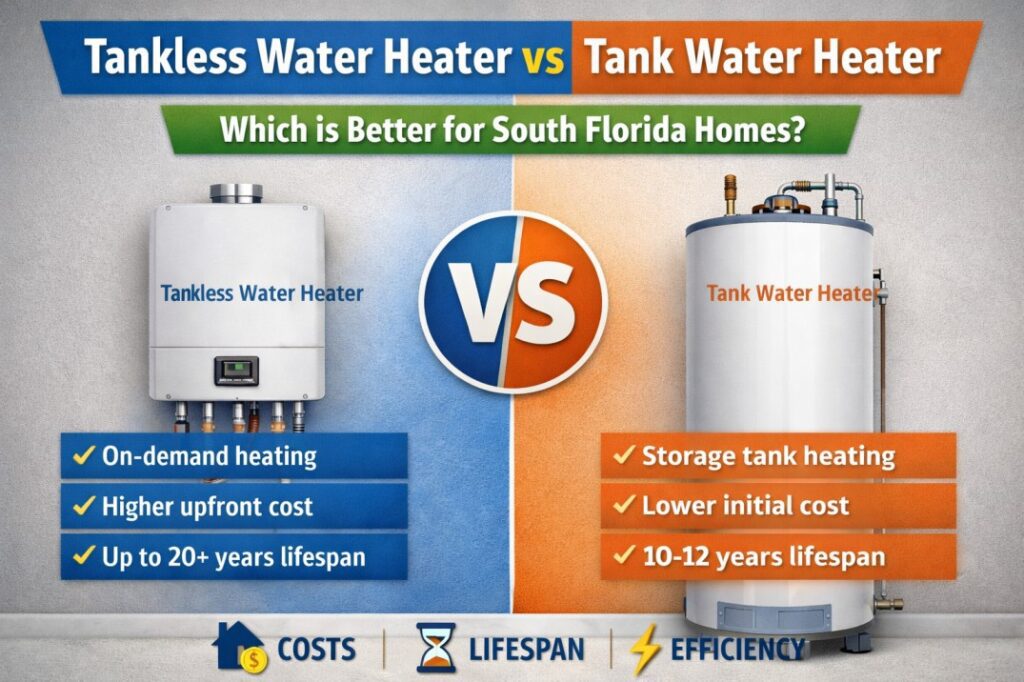
Over a 20 year tankless lifespan versus a 10 to 12 year tank lifespan, the total cost of ownership can actually favor the tankless system despite the higher upfront price. You also avoid paying for a second tank replacement during that same timeframe.
Tankless Water Heater vs Tank Water Heater Comparison for South Florida Homeowners
Lifespan and Durability
Tank water heaters typically last 10 to 12 years with proper maintenance. The main killer is sediment buildup and corrosion. Every tank has an anode rod, a sacrificial metal rod that corrodes in place of the tank walls. Once that rod is fully consumed (usually around year 5 to 7), the tank itself starts corroding from the inside out. Annual flushing and anode rod replacement can extend the life to 15 years, but most homeowners skip that maintenance and end up replacing the entire unit around the 10 year mark.
This is especially relevant in Palm Beach County. South Florida’s municipal water supply has a high mineral content. That hard water accelerates sediment buildup inside tank water heaters significantly. Homeowners in West Palm Beach, Wellington, and Boca Raton who do not flush their tanks annually often see failures closer to 8 years rather than 12. It is one of the most common issues DC Plumbing sees on service calls.
Tankless water heaters last 20 years or longer with routine maintenance. Because there is no standing water in a tank, there is no large scale sediment accumulation or tank wall corrosion. Tankless units do require annual descaling (flushing with vinegar to remove mineral deposits from the heat exchanger), which is especially important in hard water areas like South Florida. But the overall durability advantage is substantial.
Energy Efficiency and Utility Bills
Energy efficiency is the area where tankless water heaters have the clearest advantage. Because tankless units only heat water when it is being used, they eliminate standby heat loss entirely. According to the U.S. Department of Energy, tankless water heaters are 24 to 34 percent more energy efficient than conventional storage tank models for homes using 41 gallons or less of hot water per day. For homes using more than that (around 86 gallons per day), the efficiency advantage drops to about 8 to 14 percent, but tankless still wins.
For South Florida homeowners, water heating is typically the second or third largest energy expense in the home after air conditioning. Reducing that cost by even 25 percent adds up meaningfully over a decade. DC Plumbing recommends that homeowners factor in their actual daily hot water usage when deciding. A two person household in a Delray Beach condo will see different savings than a family of five in a Wellington home with multiple bathrooms.
Tank water heaters have improved in efficiency over the years. Modern units carry Energy Factor (EF) ratings that are significantly better than models from 10 or 15 years ago. If budget is the primary concern and your daily hot water usage is moderate, a high efficiency tank unit is still a solid choice.
Why South Florida Changes the Equation
Most of the comparison articles online are written for a national audience. They do not account for the factors that make South Florida different. Here is what actually matters for homeowners in Palm Beach County.
Hard water is the biggest factor. South Florida’s water supply has elevated calcium and magnesium levels that cause mineral scale buildup. In tank water heaters, this sediment settles at the bottom of the tank and reduces heating efficiency over time. It also shortens the lifespan of heating elements. In tankless units, scale builds up inside the heat exchanger and can reduce flow rates if not flushed annually. Both systems are affected, but the impact on tank units is more severe because the sediment has nowhere to go.
High ambient temperatures are actually an advantage. Because garages and utility closets in South Florida stay warm year round, tank water heaters experience less standby heat loss than they would in a Minnesota basement. The incoming cold water supply is also warmer (typically 72 to 78 degrees versus 45 to 55 degrees in northern states), which means both tank and tankless units have to work less to reach the target temperature. Tankless units sized for northern climates may actually be oversized for a South Florida installation.
Power outages during hurricane season are a consideration. If you have an electric tankless water heater and lose power during a storm, you have no hot water. The same is true for an electric tank unit, but the tank still holds 40 to 50 gallons of stored hot water that will stay warm for several hours after the power goes out. If your home runs on natural gas and you are considering a gas tankless unit, it will continue to operate during an electrical outage as long as the gas supply is intact and the unit has battery backup ignition.
Outdoor installation is possible year round. Unlike northern states where tankless units must be installed indoors to avoid freezing, South Florida homeowners can install certain tankless models on an exterior wall. This frees up interior space and simplifies venting for gas units. DC Plumbing installs outdoor tankless units regularly for homes across Jupiter, Palm Beach Gardens, and Lantana where indoor utility space is limited.
When a Tank Water Heater Is the Right Choice
A tank water heater makes sense when upfront cost is the primary concern, especially when considering water heater repair and replacement needs. If your current tank water heater just failed and you need hot water restored quickly and affordably, replacing it with a similar unit is the fastest, least expensive path. The installation is straightforward, the parts are widely available, and the job can usually be completed in a few hours, making it a practical option for urgent water heater repair and replacement situations.
Tank units also handle high simultaneous demand well, which is important when evaluating long-term water heater repair and replacement decisions. If your household regularly runs the dishwasher, laundry, and multiple showers at the same time, a large capacity tank (50 to 80 gallons) delivers consistent flow without the flow rate limitations that can affect a single tankless unit. For larger families in South Florida homes with three or more bathrooms, a tank unit may be the simpler and more reliable solution.
Maintenance is also less technical, another advantage when planning for future water heater repair and replacement. Flushing a tank and replacing an anode rod are tasks that a licensed plumber like DC Plumbing of South Florida can handle quickly during a routine service call. Tankless maintenance requires a descaling flush with specialized equipment, which is slightly more involved.
When a Tankless Water Heater Is the Better Investment
A tankless water heater is typically the better long term investment for homeowners who plan to stay in their home for 10 years or more. The energy savings, longer lifespan, and reduced replacement frequency offset the higher upfront cost over time.
Tankless is also the right call for smaller homes, condos, and townhomes where space is limited. The compact wall mounted design frees up valuable square footage. For condos in Boca Raton and Boynton Beach where every closet matters, that space savings can be a deciding factor.
If your household has moderate hot water usage (one to three people, one to two bathrooms), a single tankless unit will likely cover your needs without any flow rate issues. For larger homes, multiple tankless units or a whole house tankless system can be configured to handle higher demand, though the cost goes up accordingly.
Homeowners interested in a hybrid water heater should also consider that option. Hybrid heat pump water heaters combine a tank with a heat pump that pulls warmth from the surrounding air to heat the water. In South Florida’s warm climate, hybrid units are exceptionally efficient. DC Plumbing installs and services hybrid water heaters as well, and they are worth a conversation if you want the storage capacity of a tank with efficiency closer to a tankless system.
Frequently Asked Questions
How much does it cost to switch from a tank to a tankless water heater?
Converting from a tank to a tankless water heater in South Florida typically costs between $2,500 and $4,500 including the unit, installation, and any electrical or gas line modifications. The exact cost depends on the fuel type, location in the home, and whether your electrical panel needs an upgrade to support an electric tankless unit. DC Plumbing provides free estimates for every water heater project.
Do tankless water heaters work well with South Florida’s hard water?
Yes, but they require annual maintenance. South Florida’s hard water causes mineral scale buildup inside the tankless heat exchanger, which can reduce efficiency and flow rate over time. Annual descaling (a vinegar flush performed by a licensed plumber) keeps the unit running at peak performance. Skipping this maintenance is the most common cause of premature tankless water heater problems in Palm Beach County.
How long does a tank water heater last in South Florida?
The average tank water heater lasts 10 to 12 years nationally, but in South Florida the hard water conditions often shorten that to 8 to 10 years without regular flushing and anode rod maintenance. Annual flushing removes sediment buildup and can extend the lifespan closer to the 12 to 15 year range.
Can a tankless water heater be installed outdoors in Florida?
Yes. Because South Florida does not experience freezing temperatures, certain tankless water heater models are rated for outdoor installation. This is a popular option for homes with limited interior utility space. DC Plumbing installs outdoor tankless units for homeowners throughout Palm Beach County.
Is a tankless water heater worth it for a two person household?
For a two person household with moderate hot water usage, a tankless water heater is often the best fit. The energy savings are most pronounced in homes using 41 gallons or less per day, and a single tankless unit provides more than enough capacity for two people. The compact size is also ideal for smaller homes and condos.
Talk to a Licensed Master Plumber About Your Water Heater Options
Whether you are leaning toward a tankless water heater vs tank water heater, the best next step is an honest conversation with a licensed plumber who installs both systems and can evaluate your home’s specific needs. DC Plumbing of South Florida is a family owned, fully licensed and insured master plumber operation proudly serving Palm Beach County. Danny, the owner and second generation plumber, has over 20 years of experience and will walk you through every option with transparent pricing and zero pressure.
Call DC Plumbing at (561) 816 2835 or visit dcplumbingofsoflo.com to request a free estimate. Available 24/7 for emergencies. License CFC 1430057.